
The global beauty, personal care, and dermatological cosmetics market represents one of the primary targets for organized counterfeiting syndicates. High retail price-to-weight ratios, fervent consumer brand loyalty, and social-media-driven trends create immense commercial incentives for illicit duplication.
The risks associated with fake skincare products, however, are not merely cosmetic:
- Chemical Toxicity: Laboratory analyses of seized counterfeit lipsticks, foundations, and eye serums routinely reveal alarming concentrations of heavy metals—including lead, mercury, beryllium, and arsenic—as well as industrial solvents, animal feces, and banned topical corticosteroids (such as clobetasol).
- Severe Health Injuries: Consumers suffer chemical burns, allergic contact dermatitis, permanent skin discoloration, and chronic ocular infections.
- Brand Destruction: When a consumer experiences adverse reactions from a counterfeit purchased from an unauthorized online boutique or street market, brand equity suffers immediate, irreversible damage.
- Unauthorized Gray-Market Diversion: Authorized distributors in low-tax jurisdictions illegally divert genuine inventory into high-margin territories, cannibalizing official retail channels.
To safeguard consumers and preserve brand integrity, cosmetic brand owners and licensed commercial importers must establish unbroken physical-to-digital authentication across every retail unit.
Why Holograms and Micro-Printing Are Routinely Cloned
For decades, prestige cosmetic houses have relied on holographic stickers, hot-stamped foil crests, and micro-text. Counterfeiting syndicates, however, possess identical manufacturing technology:
- Commercial Hologram Duplication: High-resolution holographic foil mastering is widely available from contract packaging vendors across Shenzhen, Yiwu, and Southeast Asia.
- Subjective Human Judgment: Retail beauty advisors and everyday consumers cannot distinguish a 2-channel genuine optical hologram from a well-made imitation under store lighting.
- No Digital Auditability: A hologram does not communicate with a supply-chain database, cannot detect duplicate serial reuse, and provides zero forensic intelligence to customs authorities during border interdiction.
The N3CODE Advantage: Micro-Matrix Optical Cryptography on Cosmetic Containers
N3CODE provides high-end cosmetics manufacturers and commercial importers with a zero-BOM optical defense layer tailored to premium packaging aesthetics:
[COMPACT JAR / TUBE] ──> [DIRECT PART LASER / GLOSS ETCH] ──> [N3CODE MICRO-MARK]
                                                                        │
[GENUINE VERIFICATION] <── [OFFLINE ASYMMETRIC CRYPTO] <── [SMARTPHONE CAMERA]
1. Elegant Micro-Matrix Footprint (Profile B)
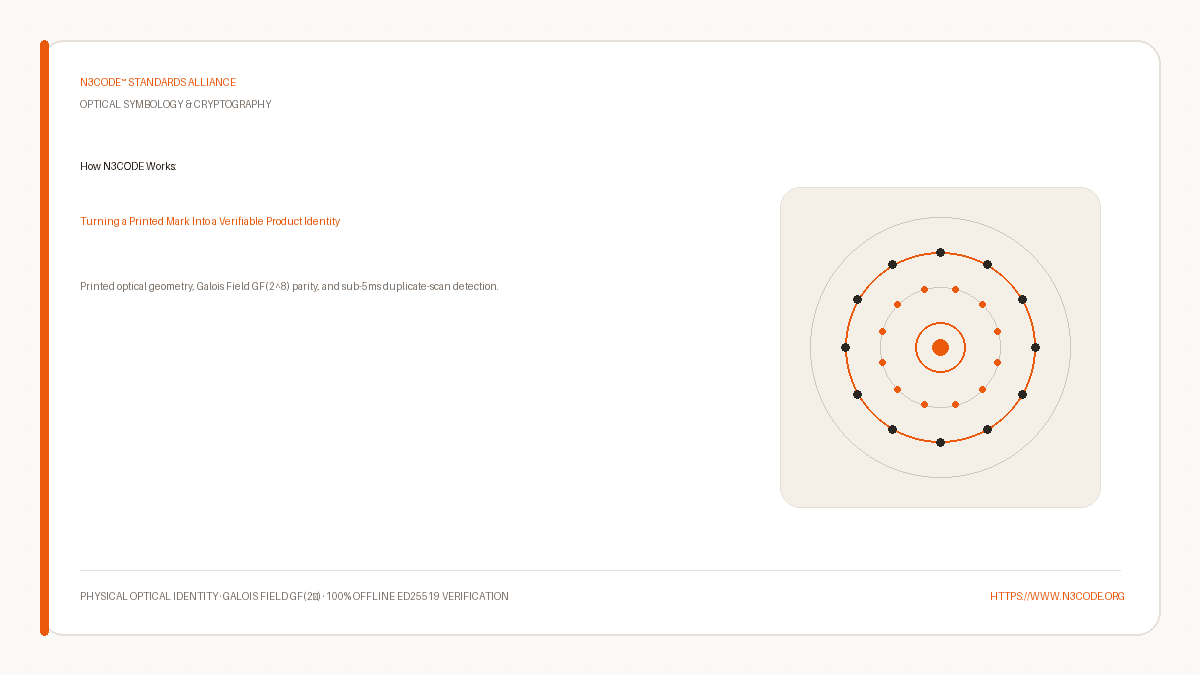
Luxury skincare packaging demands minimalist aesthetics. N3CODE's Micro-Matrix profile condenses 96 bits of cryptographic identity into an inconspicuous mark as small as 4mm × 4mm. It can be laser-annealed on metallic lipstick barrels, glass serum dropper vials, or printed on folding carton tuck-flaps without disrupting high-end visual design.
2. Glare-Resistant Optical Processing
Cosmetics containers frequently utilize high-gloss lacquers, reflective gold hot-stamping, and curved glass surfaces. N3CODE's edge computer vision engine incorporates CLAHE (Contrast-Limited Adaptive Histogram Equalization) reflection cancellation, delivering instantaneous reads even under harsh retail display spot-lighting. Learn more about choosing the right optical profile for packaging materials.
3. Dedicated Importer Verification Workflows (company_type = 'IMPORTER')
In many countries—including Bangladesh, India, Indonesia, and across the Middle East—the majority of prestige cosmetics are imported. Commercial importers configure custom secondary authentication over-stickers:
- Reconciles declared container customs manifests against physically serialized retail units.
- Detects parallel imports and undeclared contraband diverted from foreign markets.
- Provides domestic regulatory agencies (such as Bangladesh DNCRP or the US FDA) with incontrovertible proof of legal importation and customs clearance.
4. Real-Time Geodesic Anti-Diversion Intelligence
If an authorized shipment destined for Singapore begins circulating in street markets in London or Dhaka, scans trigger geodesic velocity alerts. Brand security teams immediately pinpoint rogue distributors breaching territorial exclusivity agreements. See our technical breakdown of anti-clone velocity filters.
How Beauty Brands Deploy N3CODE Without Slowing Packaging
Deploying N3CODE into continuous cosmetics manufacturing or importer repackaging lines is straightforward:
- Substrate Assessment: Choose between secondary carton tuck-flaps, bottom-of-jar laser etching, or tamper-evident seal stickers.
- Printer Integration: Mark substrates using existing CIJ, UV inkjet, or fiber laser markers at conveyor speeds exceeding 600 units per minute.
- Retailer & Consumer Mobile Empowerment: Direct consumers to verify their purchases using the free N3CODE mobile verifier app, boosting brand trust and repeat purchase confidence.
- Customs & Regulatory Collaboration: Supply customs border enforcement agencies and consumer protection bodies with audit accounts to verify imported cosmetics at container inspection yards.
Defend Beauty, Health, and Brand Trust
Cosmetic counterfeiting poses an immediate danger to public health and enterprise revenue. By implementing printed optical cryptography, cosmetics manufacturers and importers stop fakes before they reach consumers' skin.