
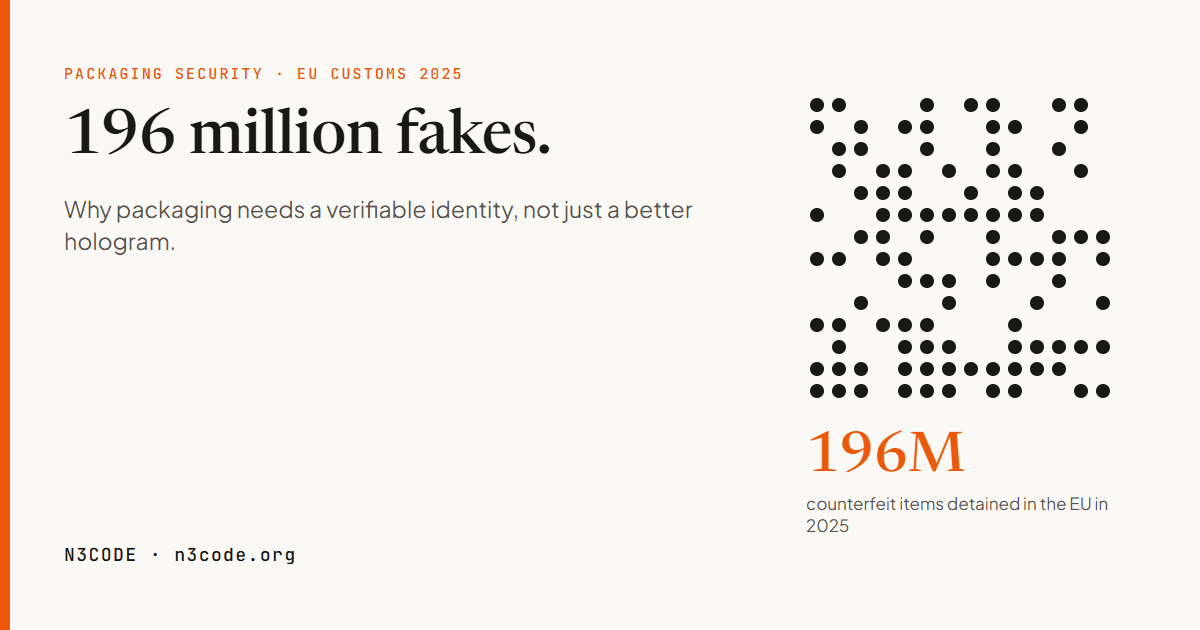
On 22 October 2026 the European Commission and the EUIPO published the 2025 results of EU customs enforcement. Customs detained 196 million counterfeit items, with an estimated value of about €6.3 billion. That is 67% more than in 2024, and the highest number on record.
Two details matter for anyone who designs or buys packaging:
- Labels, tags and stickers made up 12.82% of detained articles. Counterfeiters do not only copy products. They copy the packaging materials and identity marks that are supposed to tell a genuine product apart.
- Express courier and postal consignments linked to e-commerce remain a major channel. Small parcels reach consumers directly, often without passing through a retailer who might notice something is wrong.
Source: European Commission, Taxation and Customs Union, "EU detentions of counterfeit goods: 2025 results" (22 October 2026).
Looking genuine is no longer evidence
A copied hologram, a reprinted label or a photographed QR code can look exactly like the original. If a security feature can be copied together with the box, a consumer or inspector who sees it learns very little.
That is why the market is moving from single visual features to layered authentication, where each layer answers a different question:
| Layer | Question it answers | Example |
|---|---|---|
| Product identifier | Which product is this? | GTIN in a GS1 DataMatrix or Digital Link QR |
| Serialised identity | Which individual unit is this? | A unique serial per pack |
| Cryptographic check | Was this identity issued by the brand? | A keyed tag only the brand can compute |
| Duplicate-scan monitoring | Is this identity being reused somewhere suspicious? | The same serial scanned in two distant cities |
| Material or physical feature | Is the physical object itself original? | Security inks, PUFs, tamper bands |
No single layer does everything. A valid serial can still be copied onto a fake box. A cryptographic tag proves the identity was issued by the brand, but a perfect photocopy of a genuine mark carries the same valid tag. Duplicate-scan monitoring is what turns those copies into a signal: one identity, scanned in places and at times that one physical pack could not reach.
Four things that are often confused
Recent research on optical anti-counterfeiting, including work on luminescent materials and printed physical unclonable functions, shows growing interest in combining physical features with digital checks. It helps to keep the terms apart:
- A serial number identifies one item. It can be copied.
- A cryptographic identity carries data plus a tag that only the key holder can create. New valid identities cannot be invented without the key, but an existing one can still be photographed.
- A physical unclonable function (PUF) uses random physical variation, such as ink droplets or surface texture, as a fingerprint that is very hard to reproduce.
- Duplicate-scan analysis looks for suspicious reuse of an identity across scans.
N3CODE is a cryptographically verifiable optical mark with duplicate-scan monitoring. It is not a PUF. A material-level fingerprint is a possible future layer, and we say so plainly rather than blur the categories.
How N3CODE fits the layered model
N3CODE prints a compact optical mark on cartons, caps and foils using the printers already on the line. Each mark carries a brand ID, product index, serial number and a truncated HMAC-SHA256 tag computed with the brand's key.
- Generate: serials and tags are created per batch.
- Print: the desktop spooler sends the mark to thermal, inkjet or laser printers.
- Scan: a phone or industrial camera reads the mark.
- Verify: the tag is checked on the device with a provisioned key, so it works without a network.
- Monitor: when online, scans are compared with earlier scans, and suspicious reuse is flagged for the brand to investigate.
What a scan tells you, and what it does not:
- It does tell you whether the mark carries a valid, registered identity and whether that identity has been seen elsewhere.
- It does not test what is inside the package. A valid identity is not proof of chemical purity or safety.
Working with GS1, not against it
GS1's Ambition 2027 initiative aims for retail systems that can read both linear barcodes and 2D codes such as GS1 DataMatrix and QR codes with GS1 Digital Link. That transition is good news for authentication: it gets brands used to unit-level data on pack.
N3CODE is designed to sit next to GTINs, GS1 DataMatrix and Digital Link, not to replace them. In regulated sectors it is also not a substitute for mandated features such as the DSCSA product identifier in the US or the EU FMD unique identifier and anti-tampering device. Read more in our comparison of QR codes and product authentication.
What to do next
If counterfeit packaging is a problem for your brand, start with evidence rather than features:
- Map where copies are found: marketplaces, export routes, specific distributors.
- Decide who needs to verify: consumers, pharmacists, inspectors or your own field team.
- Test a mark on your real substrates and printers before rolling out.
Request a packaging-line assessment and we will test N3CODE on your own packaging, record read rates and failed scans, and share the results with you.