
A package can look genuine even when it is not. Counterfeit products routinely imitate familiar packaging, colours, brand typography, and even conventional barcodes. For a customer, retailer, distributor, or customs inspector, visual inspection alone cannot establish whether a product carries an authentic identity.
Traditional product codes (such as standard UPC/EAN barcodes or basic QR codes) are designed for inventory tracking. However, photographing a visible code and reproducing it on another package creates an acute security loophole: a copied identifier appears valid because the underlying symbol has no cryptographic defense against photographic duplication. To explore this failure mode in detail, see our analysis on why standard QR codes alone are vulnerable to photocopy reproduction.
Product authentication must therefore ask more than, "Can this code be read?"
It must answer: "Does this printed mark represent a cryptographically valid identity, and is there evidence that this physical identity is being copied or misused across the supply chain?"
N3CODE was engineered by NLAN Ltd. as a proprietary optical symbology and physical-to-digital product authentication platform designed to resolve this challenge directly on the packaging substrate.
What is N3CODE?
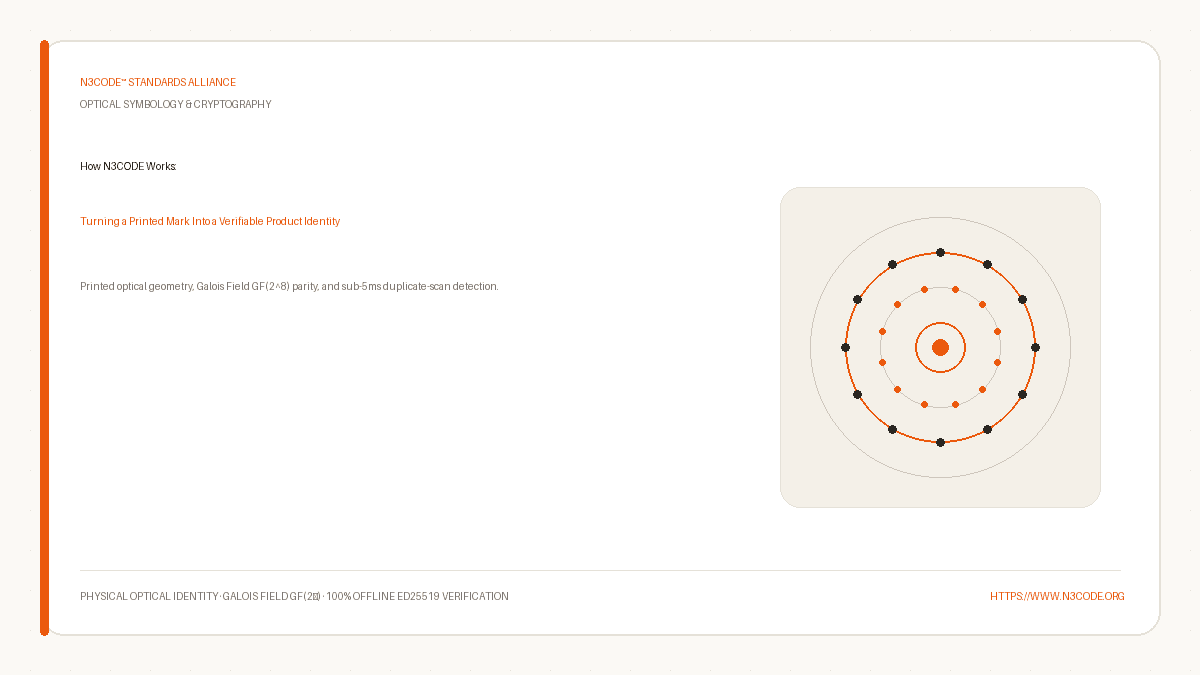
N3CODE is a printed optical identity system. Its mark is printed directly onto packaging materials—including curved HDPE bottle closures, reflective pharmaceutical blister foils, and high-speed folding cartons—and verified using a dedicated computer-vision reader.
Rather than relying on an open web URL, N3CODE packs a compact 96-bit binary payload mapped into Galois Field GF(2⁸) symbol words with a keyed HMAC-SHA256 tag checked on the device and online duplicate-scan monitoring. Review our full system architecture documentation for mathematical specifications.
The 7-Step N3CODE Verification Workflow
[1. CREATE IDENTITY] ➔ [2. GENERATE OPTICAL MARK] ➔ [3. INLINE PRINTING]
                                                             │
[7. VERIFY RESULT]   ⬅ [6. VELOCITY RADAR]        ⬅ [5. CRYPTO CHECK] ⬅ [4. SCAN MARK]
1. Create a Product Identity
A brand manufacturer establishes product parameters in their serialization workflow. The encoded payload contains:
- Tenant Key (20 bits): Unique enterprise partition ID (allocating up to 1,048,575 discrete brands).
- SKU Variant Index (16 bits): Up to 65,535 product variants per tenant.
- Unit Serial Number (40 bits): 1.09 trillion individual unit serials per SKU.
- Cryptographic Tag (28 bits on Radial): truncated HMAC-SHA256 computed with the brand key (Micro uses 8 bits, Standard 32). Key bundles for verifier devices are signed with Ed25519.
2. Generate the Optical Mark
The identity is synthesized into specialized optical micro-dot patterns with 32 bits of Reed-Solomon parity. Because mathematical error correction is embedded into the graphic, physical printing marks require zero RFID chips or electronic hardware, reducing marginal bill-of-materials (BOM) cost to $0.00. Calculate the financial ROI and cost advantages across packaging lines.
3. Print the Mark on Industrial Substrates
The mark is transferred to physical packaging using existing continuous inkjet (CIJ), thermal inkjet (TIJ), laser etching, or flexographic printheads. N3CODE provides substrate-specific profiles:
- Radial Concentric Profile: For curved bottle caps and beverage closures.
- Micro-Matrix Profile: For aluminum push-through blister packs.
- Standard Matrix Profile: For folding paperboard cartons and corrugated cases.
To learn how to connect these profiles into existing factory hardware, read our guide on integrating N3CODE into manufacturing packaging lines.
4. Scan the Physical Mark
A mobile camera running the native mobile verifier application captures the mark. The edge vision engine applies real-time homography unwarping, CLAHE (Contrast-Limited Adaptive Histogram Equalization) reflection cancellation, and perspective rectification in on the device.
5. Validate the Encoded Identity
The verifier evaluates the Reed-Solomon syndrome polynomial over GF(2⁸) and checks the tag with a provisioned, derived key. This check works offline on the device. Detecting copies of a real mark (the same serial scanned in suspicious places) needs an online check against earlier scans.
6. Check for Suspicious Duplicate Scans
When network connectivity is present, scan telemetry is checked against the central velocity radar. If an identical serial is scanned in London and Singapore within 20 minutes (>900 km/h impossible physical transit), an instant clone alert flags the item for quarantine. Learn more about combining cryptography with velocity clone detection.
7. Present Clear Verification Action
The reader presents unambiguous guidance:
- First Verified Scan (Green): Authentic product, original seal intact.
- Legitimate Re-Check (Blue): Documented inspection scan in authorized channel.
- Suspected Clone / Duplicate (Amber/Red): Serial detected simultaneously elsewhere; initiates escalation and quarantine.
Offline Cryptographic Validation vs. Live Clone Radar
| Feature | Offline Verification | Connected Cloud Radar |
|---|---|---|
| Connectivity | Zero cellular / Wi-Fi required | HTTPS telemetry sync |
| Cryptographic Tag | HMAC tag checked on device | Full audit logging |
| Damage Recovery | Reed-Solomon GF(2⁸) Berlekamp-Massey | Error telemetry analytics |
| Clone Detection | Local tamper-evident check | global velocity radar |
Industry Applications
From anti-counterfeit protection in pharmaceutical serialization and life sciences to tamper-proof seals in wine, spirits, and luxury beverages, N3CODE adds an authentication layer that sits next to DSCSA, EU FMD and Digital Product Passport requirements. It does not by itself establish compliance with any of them.
What N3CODE Verifies — and What It Does Not
Technical Scope Clarification:
N3CODE verifies that a physical package carries a cryptographically valid, authorized identity and flags suspicious duplicate use.
Verifying packaging identity is not a substitute for laboratory testing of chemical composition, sterile purity, or product safety. These measures work together to form a layered defense. Consult our technical FAQ for further architectural distinctions.
Evaluating N3CODE on Your Packaging Lines
A practical evaluation starts on the factory floor with representative packaging materials:
- Identify Substrates: Measure available print area and surface curvature.
- Sample Printing: Run test vectors with your current CIJ, TIJ, or laser equipment.
- Scan Testing: Validate read-rates across lighting angles and physical handling with the mobile scanner app.
- Integration Audit: Test raw TCP socket ZPL streaming (Port 9100) at conveyor line speed (>720 packs/min).
Explore Packaging Symbology Specifications · Consult the Technical FAQ · Review System Architecture · Explore Licensing & Pricing Tiers