
A product authentication technology can possess elegant mathematics, yet fail if it halts high-speed factory lines, requires specialized proprietary inks, or demands constant internet connectivity.
The operational benchmark for packaging engineers is straightforward:
Can the security mark be printed using existing industrial equipment at line speed, with no chip or tag cost per unit and without waiting for the network?
N3CODE was architected specifically to meet industrial production requirements. For the underlying authentication principles, start by reviewing how N3CODE product authentication works.
1. Eliminating the Cloud Latency Bottleneck
Many cloud-based serialization services generate print bitmaps via HTTPS REST APIs. On a line running 600 packs per minute, a package passes the printhead every 100 milliseconds.
A cloud round trip of that length can starve the printhead buffer and stall the line. To understand why older barcode models fail in high-speed and secure applications, see why QR codes alone may not be enough.
The N3CODE Solution: Native Socket Spooling (^GF)
- Local Pre-Allocation: Cryptographic serial pools are securely provisioned to local packaging plant controllers in advance.
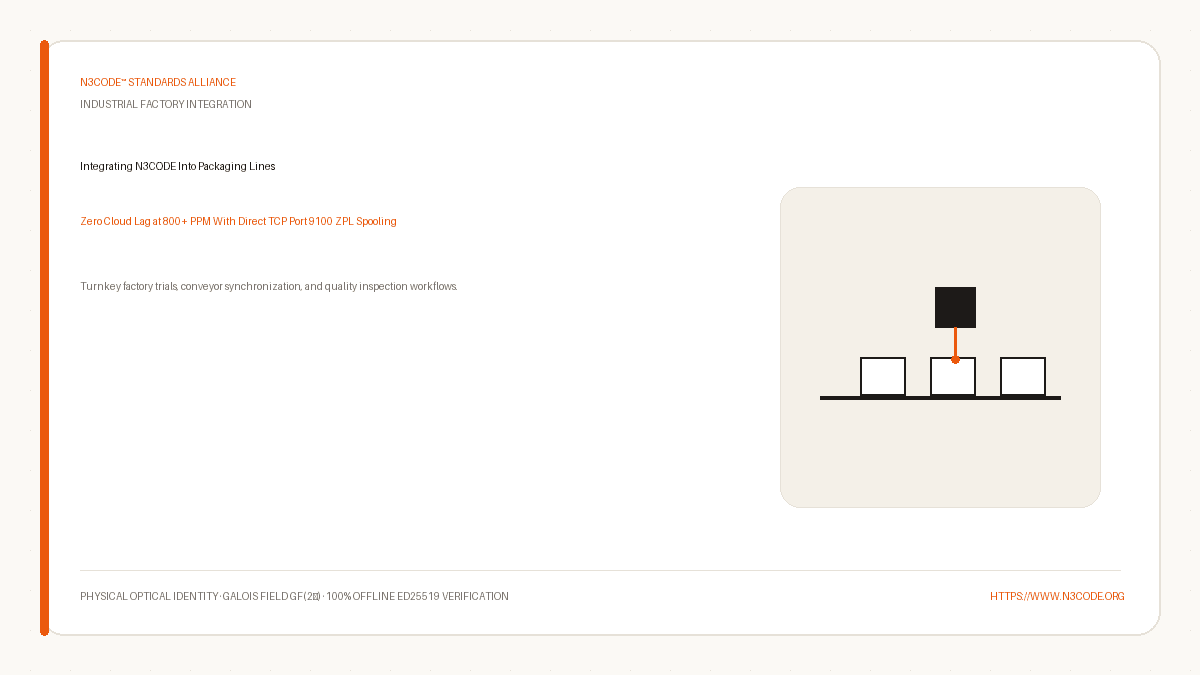
- Raw TCP Socket Streaming: The lightweight Tauri Industrial Spooler establishes direct socket connections over local LAN to printer Port 9100.
- Hardware Agnostic: Streams compressed ZPL II (^GF) and TSPL bytecode directly to standard Zebra, Videojet, Domino, Markem-Imaje, and Linx industrial printers.
- Line Speed: Serial blocks are pre-buffered locally, so printing does not wait for the network. The real line rate depends on your printer and is measured during a packaging-line assessment.
2. Nine-Step Manufacturing Integration Framework
[1. Process Mapping]  ➔ [2. Substrate Profile Selection] ➔ [3. Printer Interface Audit]
                                                                     │
[6. Verification Test] ⬅ [5. Production Line Pilot]      ⬅ [4. Serial Allocation]
       │
[7. QA Ownership]     ➔ [8. Data Security & KMS]         ➔ [9. Regulatory Handshake]
Step 1: Map the Existing Line
Document conveyor speed, pitch, substrate material, ink cure times, and printhead mounting distances.
Step 2: Select the Substrate Profile
Match your package geometry using substrate-tuned optical profiles:
- Curved Caps / Closures: Profile A (Radial Concentric).
- Blister Foils / Glass: Profile B (Micro-Matrix with CLAHE).
- Cartons / Shipping Cases: Profile C (Standard Matrix).
Step 3: Check Printer Interface Compatibility
Verify direct TCP/IP socket connectivity (Port 9100) or RS-232 serial communication with your marking equipment.
Step 4: Design the Cryptographic Serialization Workflow
Define batch sizes, brand tenant IDs, SKU indices, and HSM key rotation policies. Review our complete system architecture for bitstream layouts.
Step 5: Validate Printing Under Production Conditions
Print sample runs at 203, 300, and 600 DPI. Conduct Sutherland rub resistance and optical contrast measurements.
Step 6: Test the Dual Verification Process
Confirm that edge readers running the N3CODE mobile scanner app check the tag on the device without a network, and that the online service flags simulated duplicate serial scans. For algorithmic specifics, read our guide on cryptography and duplicate-scan detection.
Step 7: Establish Quality Assurance Ownership
Integrate automated vision rejection triggers for poorly printed marks or low-contrast ink splatters.
Step 8: Secure Key Infrastructure
Store signing keys in dedicated enterprise KMS vaults (AWS KMS, Azure Key Vault, or on-premise PKCS#11 HSMs).
Step 9: Establish Regulatory Interoperability
Ensure N3CODE marks coexist seamlessly with statutory barcodes (such as DSCSA 2D DataMatrix codes or the EU FMD unique identifier across regulated industries) without violating packaging quiet zones.
Technical Feasibility Checklist for Plant Managers
- Line speed requirement defined (e.g. 300 PPM, 600 PPM or higher).
- Printer model identified (Zebra, Videojet, Domino, Markem-Imaje, etc.).
- Available mark footprint measured on primary substrate.
- Offline operation policy documented for factory network outages.
- Test vector evaluation scheduled with N3CODE systems engineering.
Schedule an Industrial Line Trial · Download Mobile Scanner APK · Review Technical Architecture · Consult the Technical FAQ