
When evaluating product authentication security, packaging engineers face two distinct threats:
- The Math Challenge: Was this product identity issued by an authorized brand system, or was it fabricated by a third party?
- The Physical Copy Challenge: If a legitimate mark was copied onto 10,000 unauthorized packages, how does the system detect the duplicated items?
These questions require different technological layers. Cryptography proves digital validity; scan-event telemetry proves whether that identity is being duplicated in physical space. For a baseline overview of the end-to-end authentication chain, read how N3CODE product authentication works.
Layer One: Keyed Cryptographic Tag
N3CODE integrates asymmetric cryptography directly into its 96-bit binary payload:
- Key Authority: The brand key lives in a KMS. Each mark carries a truncated HMAC-SHA256 tag computed with a batch key; key bundles sent to verifier devices are signed with Ed25519.
- Embedded Signature Words: A 28-bit truncated signature word is packed alongside the 20-bit Tenant Key, 16-bit SKU ID, and 40-bit Serial Number.
- Offline Mathematical Validation: Edge readers evaluate the signature against pre-loaded public root keys in on the device with zero cloud latency.
What a Signature Proves: A verified signature proves that the encoded bitstream was created by the brand's authorized system. It does not prove that the mark has never been photographed or reprinted. To see why this makes open barcodes vulnerable, read our comparison on why QR codes alone may not be enough.
Layer Two: Geodesic Velocity Radar (Duplicate-Scan Detection)
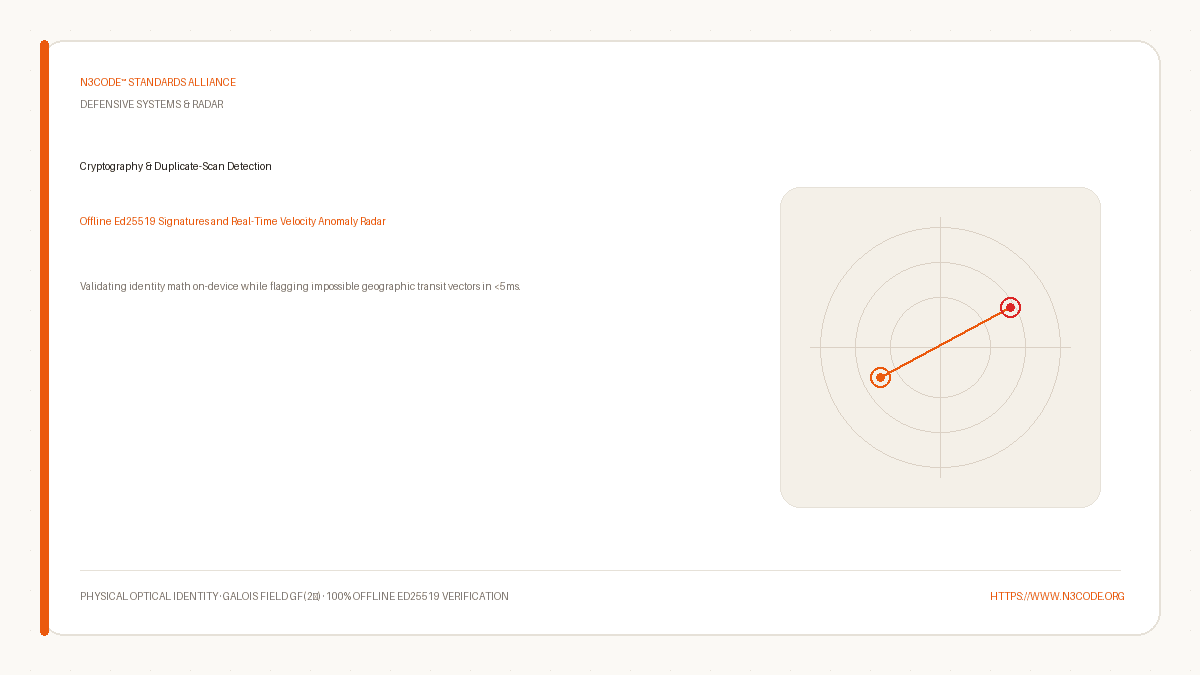
When a counterfeiter replicates an authentic mark, both the original and fake packages carry valid signatures. This is where N3CODE's Geodesic Velocity Filter activates:
Scan Event A: Paris, France (14:15 GMT) ──┐
                                          ├── Distance: 9,600 km, Time Delta: 25 mins
Scan Event B: Tokyo, Japan  (14:40 GMT) ──┘   Implied Velocity: 23,040 km/h (IMPOSSIBLE)
                                              ➔ ACTION: FLAG CLONE & NOTIFY CUSTOMS
The Mathematical Formula:
$$\text{Velocity} = \frac{\text{GreatCircleDistance}(\text{Lat}_1, \text{Lon}_1, \text{Lat}_2, \text{Lon}_2)}{\Delta t}$$
If the calculated velocity between successive scans of the same serial number exceeds 900 km/h (the commercial aviation speed ceiling), the central telemetry engine triggers an immediate clone alert. For details on how telemetry flows through cloud controllers, examine our system architecture documentation.
Layer Three: Reed-Solomon GF(2⁸) Error Correction
Physical marks on packaging endure abrasion, moisture, folds, and scratches. N3CODE allocates 32 bits of Reed-Solomon parity over the Galois Field irreducible generator:
$$p(x) = x^8 + x^4 + x^3 + x^2 + 1 \quad (0\text{x}11D)$$
Using the Berlekamp-Massey decoding algorithm, the verifier recovers the complete serial payload even if up to 25% of the printed mark is completely destroyed or obscured. Learn how this error-recovery operates across caps, blister foils, and carton substrates.
Comprehensive Security Matrix
| Security Layer | Primary Question | Technical Mechanism |
|---|---|---|
| Cryptographic Validation | Was data issued by the genuine brand? | Truncated HMAC-SHA256 tag |
| Optical Error Recovery | Can the mark be read through scratches? | GF(2⁸) Berlekamp-Massey Reed-Solomon math |
| Duplicate Clone Radar | Is the serial being duplicated in physical space? | Geodesic Velocity Filter |
| Tamper Closure Integrity | Has the container been opened or refilled? | Physical shear lines across Radial cap marks |
Incident Response Framework for Clone Alerts
When a duplicate scan alert fires:
- Severity Classification: Distinguishes routine warehouse re-scans from geographic velocity anomalies.
- Chain of Custody Logging: Retains encrypted scan timestamps, coarse GPS coordinates, and device attestation.
- Automated Escalation: Triggers webhooks to enterprise ERP (SAP, Oracle) and sends SMS/Slack alerts to regional brand protection managers.
Explore our deployment guide on integrating N3CODE into manufacturing packaging lines to configure real-time alert routing.
Read Full Architectural Specifications · Explore Industrial FAQ · Review Enterprise ROI & Licensing