
Packaging substrates are diverse: high-density polyethylene (HDPE) bottle caps, metallic pharmaceutical push-through blister foils, corrugated paperboard, and coated folding cartons.
Each material presents unique optical challenges:
- Curved surfaces distort circular coordinate planes.
- Specular metallic foils create camera glare that blinds conventional barcode scanners.
- Porous cardboard causes unpredictable ink bleed and dot gain.
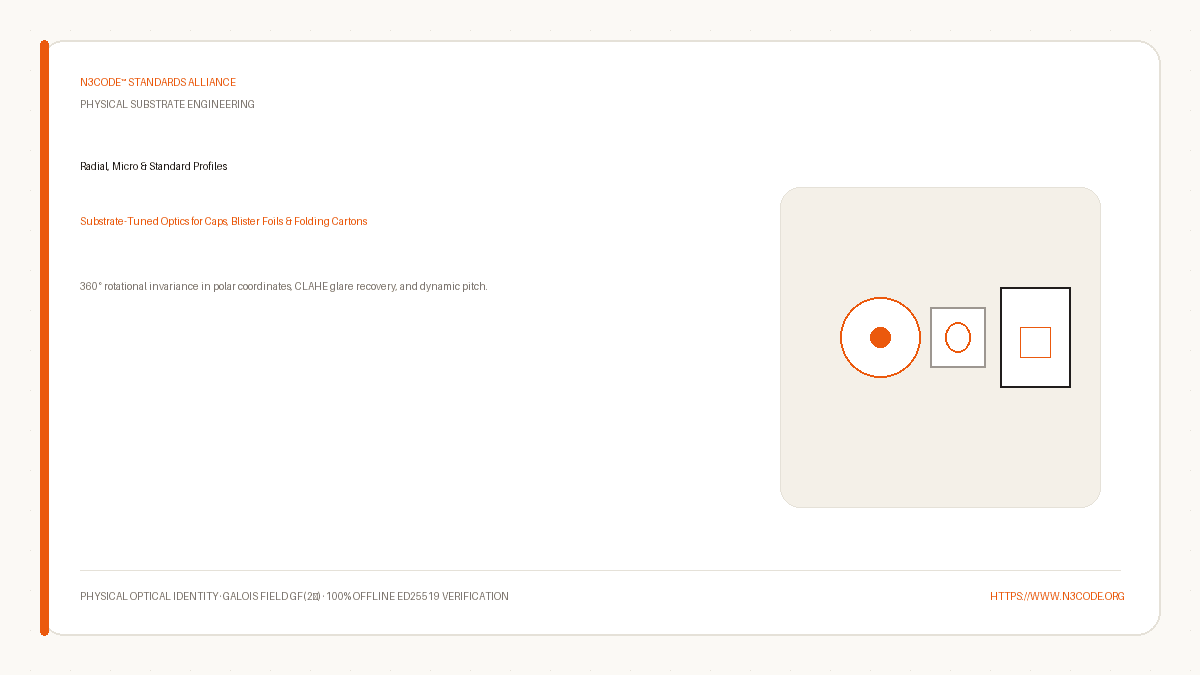
To deliver reliable verification, N3CODE standardizes three substrate-oriented optical profiles. For the foundational mathematical bitstream shared across all three, review how N3CODE product authentication works.
1. Profile Type A: Radial Concentric (Caps & Closures)
        ╭──────────────╮
     ╭──╯  (•)  (•)    ╰──╮   360° Rotational Invariance in Polar Coordinates (r, θ)
    │  (•)   ● N3CODE (•) │   Tamper-Evident Shear Perforation
     ╰──╮  (•)  (•)    ╭──╯   Engineered for Curved HDPE / Aluminum Bottle Closures
╰──────────────╯- Intended Substrates: Beverage closures, spirits caps, pharmaceutical bottle lids, and tear bands.
- Key Engineering Principle: 360° rotational invariance in polar coordinates $(r, \theta)$. A conveyor camera or consumer smartphone using the N3CODE mobile scanner app can decode the cap at any angle without manual orientation.
- Physical Tamper Proof: Cap rotation shears the micro-dot geometry along factory perforations, permanently rendering the code unreadable to prevent bottle refilling. See how this protects wine, spirits, and luxury beverages from refill fraud.
2. Profile Type B: Micro-Matrix (Blister Foils & Glass Ampoules)
- Intended Substrates: Pharmaceutical push-through blister foils, small-diameter glass vials, and surgical packaging.
- Glare Suppression with CLAHE: Employs Contrast-Limited Adaptive Histogram Equalization directly in edge shaders to cancel harsh specular reflections from metallic foil under overhead factory lights.
- Puncture Resistance: Reed-Solomon parity recovery lets the mark decode when a limited number of blocks are damaged during pill extraction; the limit depends on the profile and type of damage. Read about compliance and serialization across pharmaceutical industries.
3. Profile Type C: Standard Matrix (Cartons & Secondary Packaging)
- Intended Substrates: Folding cartons, corrugated shipping cases, and thermal transfer adhesive labels.
- Dynamic Clock Tracks: Uses perimeter timing tracks calibrated for up to $\pm 15%$ dot gain or ink bleed across porous recycled paperboard.
- High-Speed Line Spooling: Generates vectorized compressed ZPL II (^GF) bitmaps streamed directly over TCP/IP (Port 9100) without waiting for the network; the real line rate is validated per installation. Learn how this works in our guide to integrating N3CODE into factory packaging lines.
Technical Profile Comparison
| Specification | Profile A (Radial) | Profile B (Micro) | Profile C (Standard) |
|---|---|---|---|
| Target Packaging | Curved Bottle Closures | Blister Foils & Vials | Folding Cartons & Labels |
| Geometric Symmetry | Polar Concentric (360°) | Compact Orthogonal Grid | Dynamic-Pitch Matrix |
| Minimum Print Area | 12mm diameter | 8mm × 8mm | 14mm × 14mm |
| Optimal Resolution | 203–300 DPI | 300–600 DPI | 203–300 DPI |
| Anti-Tamper Mechanism | Shear line destruction | Puncture tolerance | Surface void destruction |
Step-by-Step Substrate Qualification Protocol
- Substrate Audit: Measure surface energy, specular reflectivity, and curvature radius.
- Test Vector Generation: Produce sample sheets across 203, 300, and 600 DPI resolutions.
- Lighting Envelope Testing: Validate camera decoding under diffuse, directional, and low-light environments with the mobile verifier.
- Abrasion Simulation: Subject printed samples to Sutherland rub tests and chemical wipe trials before deployment.
- Clone Telemetry Testing: Verify that scanned samples link properly with cryptographic signature and duplicate-scan detection engines.
Review Symbology Mathematical Physics · Consult Packaging Technical FAQ · Explore Country-Specific Pricing Tiers